Welcome to the CompTIA PenTest+ Certification (PT0-003) independent practice questions and answers listing page. Here, you will find a comprehensive collection of 540 authentic practice questions designed to help you prepare effectively for the certification. This resource is tailored for those seeking to understand the types of questions encountered on the actual exam, allowing you to familiarize yourself with the format and subject matter.
To get the most out of these practice questions, we recommend starting by taking a diagnostic test to assess your current knowledge level and identify areas that require further study. Use the questions to simulate the exam experience by setting a timer and answering in a quiet environment. After completing the questions, review your answers carefully to understand any mistakes you made and to reinforce your understanding of the correct concepts.
As you prepare for the CompTIA PenTest+ Certification, consider these study tips:
1. Regular Study Sessions: Consistency is key. Schedule dedicated study sessions each week and break your study materials into manageable sections to avoid burnout.
2. Hands-On Practice: Engage in hands-on labs and real-world scenarios that complement your theoretical knowledge. This practical experience will deepen your understanding of penetration testing concepts and tools.
3. Join Study Groups: Collaborating with peers can provide diverse perspectives and insights. Join or form a study group to discuss challenging topics and share resources.
By effectively utilizing the practice questions and applying these study strategies, you will be well-equipped to confidently tackle the CompTIA PenTest+ Certification exam.
Which technology allows devices to communicate when they are brought within close proximity, typically less than 4 inches (<10 centimeters)?
OBJ 4.9: Near-field communication (NFC) allows devices to communicate when they are brought within close proximity, typically within a few centimeters/inches. This technology is used in contactless payment systems and for exchanging data between devices. Wi-Fi is used for wireless local area networking, RFID is for identification and tracking, and Zigbee is a specification for a suite of high-level communication protocols using low-power digital radios. For support or reporting issues, include Question ID: 66d10c057e3a9ecad46e8c61 in your ticket. Thank you.
During an assessment of a client's cloud-based services, you find that sensitive information, such as user credentials and personal data, is being stored in system logs. These can be exploited by attackers who gain access to these logs. What type of attack types does this scenario represent?
OBJ 4.6: This scenario describes logging information exposure, where sensitive data is included in logs, making it accessible to attackers who gain access to the logs. Properly sanitizing and securing log files helps mitigate this risk. Third-party integrations involve insecure external connections, resource misconfiguration refers to improperly set up cloud resources, and image and artifact tampering involves the compromise of software components. For support or reporting issues, include Question ID: 66d10a610f45d8a219a246a0 in your ticket. Thank you.
A new piece of malware attempts to exfiltrate user data by hiding the traffic and sending it over a TLS-encrypted outbound traffic over random ports. What technology would be able to detect and block this type of traffic?
OBJ 1.5 - A web application firewall (WAF) or application-aware firewall would detect both the accessing of random ports and TLS encryption and identify it as suspicious. An application-aware firewall can make decisions about what applications are allowed or blocked by a firewall, and TLS connections are created and maintained by applications. A stateless packet inspection firewall allows or denies packets into the network based on the source and destination IP address or the traffic type (TCP, UDP, ICMP, etc.). A stateful packet inspection firewall monitors the active sessions and connections on a network. The process of stateful inspection determines which network packets should be allowed through the firewall by utilizing the information it gathered regarding active connections as well as the existing ACL rules. Neither a stateless nor stateful inspection firewall operates at layer 6 or layer 7, so they cannot inspect TLS connections. An intrusion detection system (IDS) is a device or software application that monitors a network or systems for malicious activity or policy violations. An IDS only monitors the traffic on the network, it cannot block traffic. For support or reporting issues, include Question ID: 63fe10763b7322449ddc3f1c in your ticket. Thank you.
Jake, a penetration tester, performs a lock-picking exercise at a client’s facility. He unlocks the main office door in less than two minutes using a standard lock-picking tool. What recommendation should Jake give to improve the physical security of the facility?
OBJ 3.3 - Jake should suggest upgrading the mechanical locks to more advanced options, such as electronic or biometric locks. These are harder to bypass and would increase the overall security of the facility by preventing easy unauthorized access. For support or reporting issues, include Question ID: 66e1f9b79ffadcf0b0ed0c33 in your ticket. Thank you.
You have completed your penetration test using cloud-based infrastructure for testing. What should be your next step in terms of managing this infrastructure?
OBJ 5.4: Spinning down the infrastructure after completing a penetration test is essential to prevent unnecessary costs and to reduce potential security risks associated with leaving resources operational. Leaving the infrastructure running or transferring ownership without proper decommissioning could lead to unintended security exposures. For support or reporting issues, include Question ID: 66d6ae6c018f237d606c0fab in your ticket. Thank you.
You have been asked to monitor any new devices that come online in a client's network that match a specific set of criteria related to their security configuration. Which feature in Shodan would you use to automate this process?
OBJ 2.4 - Shodan Alerts allows you to set up monitoring for specific IP ranges or search queries. Shodan will automatically notify you when new devices matching your criteria are found, which is ideal for continuous monitoring. Shodan Explorer is for browsing the Shodan database, while Shodan CLI is a command-line interface. Shodan Maps visualizes device locations but does not provide real-time alerts. For support or reporting issues, include Question ID: 66e078fe03067bb5e8e8d2bb in your ticket. Thank you.
Which of the following tools provides a penetration tester with PowerShell scripts that can maintain persistence and cover their tracks?
OBJ 4.1 - Powersploit is a series of Microsoft PowerShell scripts that pen testers can use in post-exploit scenarios. Empire (PowerShell Empire) is a post-exploitation framework for Windows devices that allows the attacker to run PowerShell agents without needing powershell.exe. It is commonly used to escalate privileges, launch other modules to capture data, extract passwords, and install persistent backdoors. Searchsploit is a tool included in the exploitdb package on Kali Linux that enables you to search the Exploit Database archive. Responder is a fake server and relay tool that is included with Kali Linux. It responds to LLMNR, NBT-NS, POP, IMAP, SMTP, and SQL queries to possibly recover sensitive information such as user names and passwords. For support or reporting issues, include Question ID: 63fe10943b7322449ddc4097 in your ticket. Thank you.
What is the proper threat classification for a security breach that employs brute-force methods to compromise, degrade, or destroy systems?
OBJ 4.3 - Attrition attacks employ brute-force methods to compromise, degrade, or destroy systems, networks, or services. An impersonation attack occurs when the attacker gains control of an employee's account and uses it to convince other employees to perform fraudulent actions. Improper usage occurs when an employee or other authorized user utilizes the systems or networks not as intended or designed. The loss or theft of equipment usually relates to a smartphone, tablet, or laptop being lost or stolen, and then the data on it becomes compromised. For support or reporting issues, include Question ID: 63fe10243b7322449ddc3b05 in your ticket. Thank you.
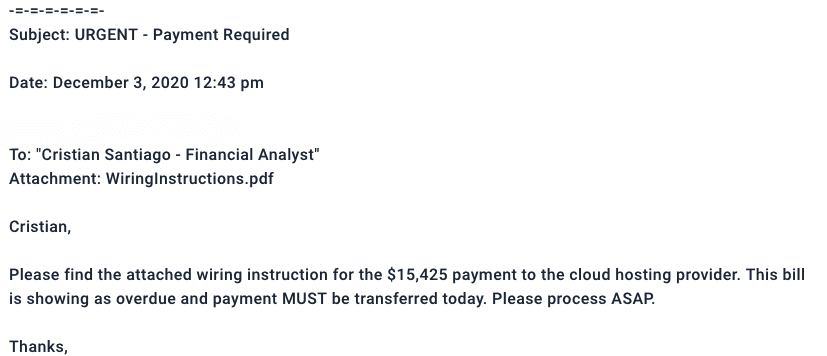
While conducting a penetration test against an organization, you gained access to the CEO's account. You log in as the CEO and send the following email:

Which of the following attacks are you utilizing in this scenario?
OBJ 4.8 - A business email compromise (BEC) is a form of elicitation where the attacker impersonates a high-level executive or directly takes over their email account. The attacker then sends an email to elicit personnel to take action on their behalf. In this example, the attacker is impersonating the company's CEO by sending an email to the financial personnel requesting they send a money transfer for what appears to be a legitimate service. This example also uses the urgency and authority motivation factors to convince the employee to take action. For support or reporting issues, include Question ID: 63fe103f3b7322449ddc3c63 in your ticket. Thank you.
You are reverse engineering a malware sample using the Strings tool when you notice the code inside appears to be obfuscated. You look at the following line of output on your screen:

Based on the output above, which of the following methods do you believe the attacker used to prevent their malicious code from being easily read or analyzed?
OBJ 2.3 - While there are many different formats used by attackers to obfuscate their malicious code, Base64 is by far the most popular. If you see a string like the one above, you can decode it using an online Base64 decoder. I recommend you copy the string above and decode it to see how easy it is to reverse a standard Base64 encoded message. Some more advanced attackers will also use XOR and a key shift in combination with Base64 to encode the message and make it harder to decode, but using a tool like CyberChef can help you decode those. Structured Query Language (SQL) is used to communicate with a database. Extensible Markup Language (XML) is a markup language that defines a set of rules for encoding documents in a human-readable and machine-readable format. SQL and XML are not considered obfuscation techniques. A QR Code is a two-dimensional version of the barcode, known from product packaging in the supermarket. QR coding is the process of converting some data into a single QR code. QR coding might be considered a form of obfuscation, but it is not shown in this question's example output. For support or reporting issues, include Question ID: 63fe10983b7322449ddc40c9 in your ticket. Thank you.
Frequently Asked Questions
How realistic are the practice questions for the CompTIA PenTest+ exam?
The practice questions closely mirror the style and complexity of the actual CompTIA PenTest+ exam, providing a realistic experience to help you prepare effectively.
How should I use these practice questions to prepare for the exam?
Utilize the practice questions to identify your strengths and weaknesses, focusing on areas where you need improvement, and simulate real exam conditions by timing yourself while answering.
How many practice questions should I complete before taking the real exam?
While there's no set number, completing at least 70-80% of the 540 practice questions will give you a comprehensive understanding of the material and help boost your confidence.
Can I retake the practice questions to improve my scores?
Yes, retaking practice questions is encouraged as it allows you to reinforce your knowledge and track your improvement over time.
Is there an explanation for each practice question to enhance my learning?
Yes, many practice question sets include explanations for correct and incorrect answers, helping you understand the concepts behind the questions.