
Microsoft Certified: Azure Cosmos DB Developer Specialty - (DP-420) Exam Questions

The practice exam for the Microsoft Certified: Azure Cosmos DB Developer Specialty (DP-420) is designed to provide candidates with an opportunity to evaluate their knowledge and readiness for the actual certification test. Comprising a total of 143 practice questions that closely mirror the format and content of the official exam, this resource allows candidates to familiarize themselves with the types of scenarios and challenges they will encounter.
By taking this practice exam, candidates can gauge their understanding of Azure Cosmos DB concepts, data modeling, and database management skills. Each question serves as a tool for self-assessment, helping to identify strengths and pinpoint areas needing further study. This targeted approach enables candidates to focus their preparation efficiently, ensuring they’re well-equipped to tackle the challenges of the certification exam.
Whether you are brushing up on your current knowledge or diving into preparation for the first time, the practice exam is an invaluable step in the certification journey, allowing you to simulate the testing experience and build confidence in your abilities.
Welcome to our dedicated listing page for real exam questions and answers tailored to the Microsoft Certified: Azure Cosmos DB Developer Specialty (DP-420). Here, you will find a comprehensive collection of 143 authentic practice questions designed to help you familiarize yourself with the exam format and content. Each question has been curated to reflect the types of scenarios and challenges you may encounter on the actual test.
To get the most out of your study session, you can navigate through the questions and evaluate your knowledge in various areas related to Azure Cosmos DB development. Make sure to engage with the explanations and rationale behind the answers to strengthen your understanding of key concepts.
To enhance your chances of passing the certification exam, consider these study tips:
1. **Understand the Core Concepts**: Dive deep into the fundamental principles of Azure Cosmos DB, including its architecture, consistency models, and data handling practices. A solid grasp of these concepts will enable you to tackle a variety of questions effectively.
2. **Practice Regularly**: Use the practice questions to simulate exam conditions. Regular testing not only reinforces your knowledge but also helps you manage your time during the actual examination.
3. **Leverage Official Resources**: In addition to using practice questions, consult Microsoft's official documentation, learning paths, and training modules relevant to Azure Cosmos DB. These materials often provide insights and additional context that can be vital for your understanding and exam success.
By following these strategies, you can approach your preparation with confidence and increase your likelihood of achieving a passing score in the DP-420 certification exam.
Question 1 Single Choice
HOTSPOT -
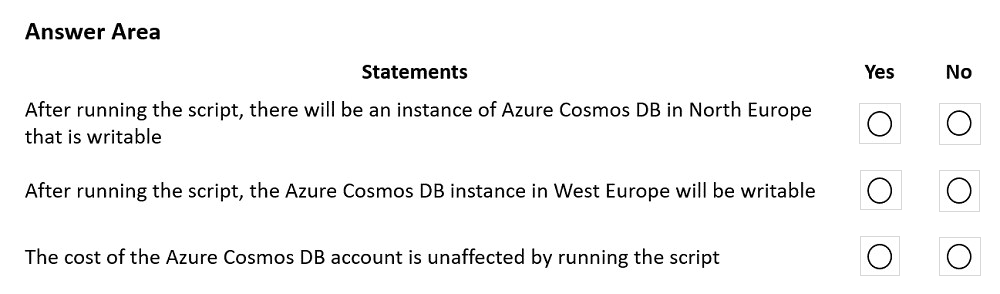
You have an Azure Cosmos DB Core (SQL) account that has a single write region in West Europe.
You run the following Azure CLI script.

For each of the following statements, select Yes if the statement is true. Otherwise, select No.
NOTE: Each correct selection is worth one point.
Hot Area:

Question 2 Single Choice
HOTSPOT -
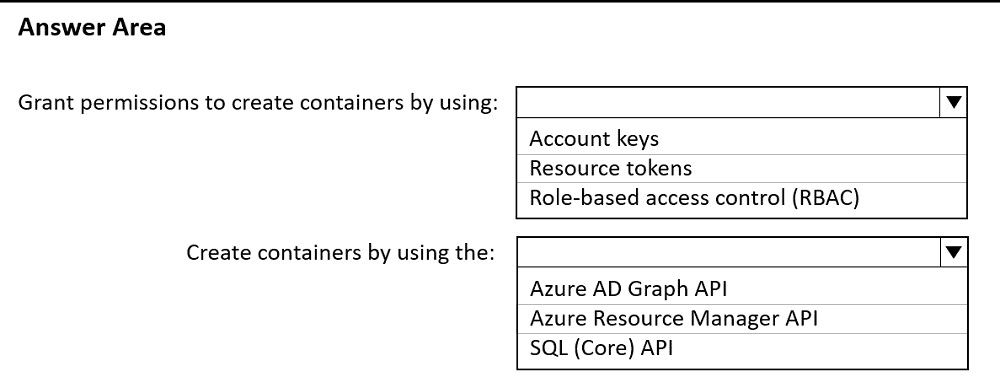
You have an Azure Cosmos DB Core (SQL) API account named account1 that has the disableKeyBasedMetadataWriteAccess property enabled.
You are developing an app named App1 that will be used by a user named DevUser1 to create containers in account1. DevUser1 has a non-privileged user account in the Azure Active Directory (Azure AD) tenant.
You need to ensure that DevUser1 can use App1 to create containers in account1.
What should you do? To answer, select the appropriate options in the answer area.
NOTE: Each correct selection is worth one point.
Hot Area:
Question 3 Single Choice
You have an Azure Cosmos DB Core (SQL) API account.
You run the following query against a container in the account.
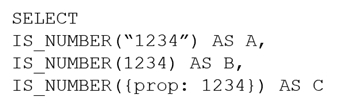
What is the output of the query?
Question 4 Single Choice
You maintain a relational database for a book publisher. The database contains the following tables.
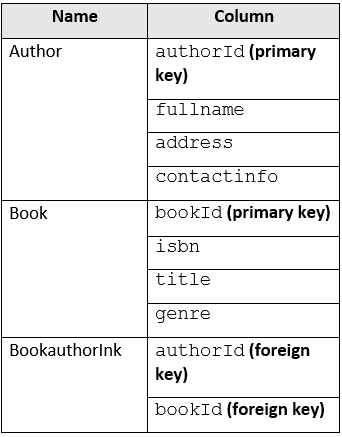
The most common query lists the books for a given authorId.
You need to develop a non-relational data model for Azure Cosmos DB Core (SQL) API that will replace the relational database. The solution must minimize latency and read operation costs.
What should you include in the solution?
Question 5 Single Choice
You are designing an Azure Cosmos DB Core (SQL) API solution to store data from IoT devices. Writes from the devices will be occur every second.
The following is a sample of the data.
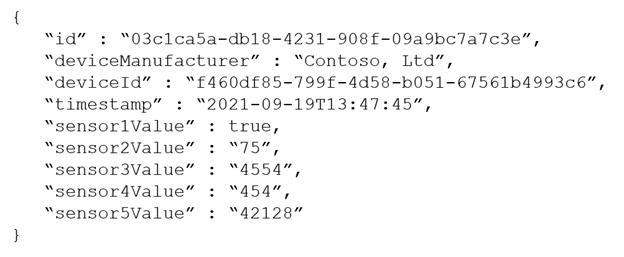
You need to select a partition key that meets the following requirements for writes:
✑ Minimizes the partition skew
✑ Avoids capacity limits
✑ Avoids hot partitions
What should you do?
Question 6 Single Choice
HOTSPOT -
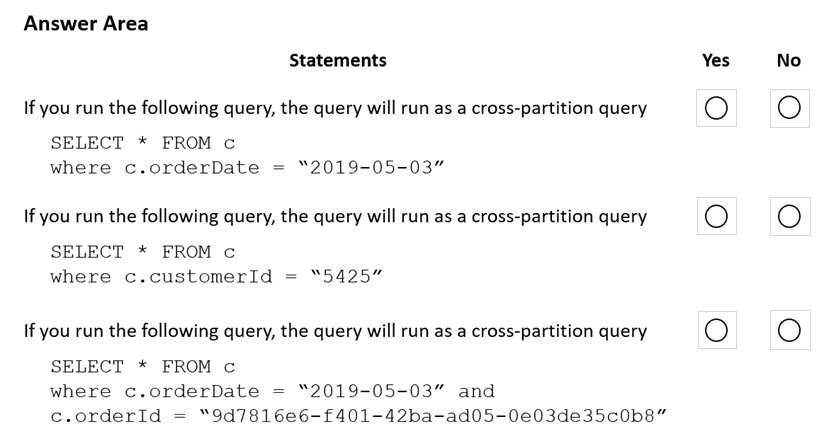
You have a container named container1 in an Azure Cosmos DB Core (SQL) API account. The container1 container has 120 GB of data.
The following is a sample of a document in container1.
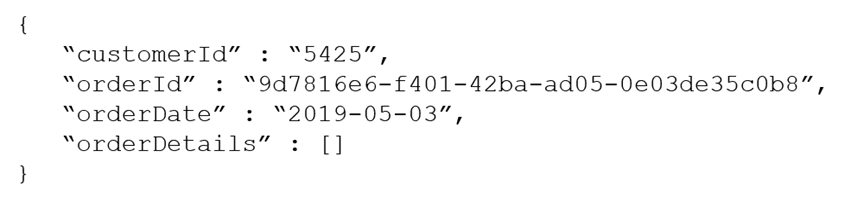
The orderId property is used as the partition key.
For each of the following statements, select Yes if the statement is true. Otherwise, select No.
NOTE: Each correct selection is worth one point.
Hot Area:
Question 7 Single Choice
HOTSPOT -
You have a database in an Azure Cosmos DB Core (SQL) API account.
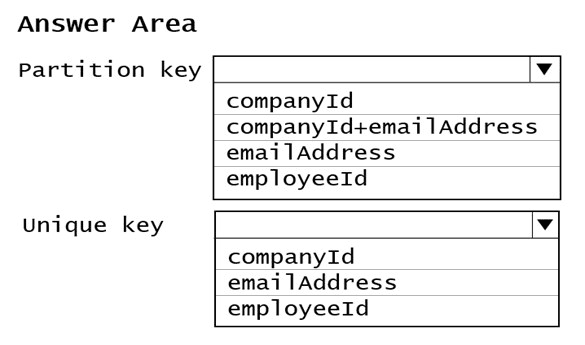
You plan to create a container that will store employee data for 5,000 small businesses. Each business will have up to 25 employees. Each employee item will have an emailAddress value.
You need to ensure that the emailAddress value for each employee within the same company is unique.
To what should you set the partition key and the unique key? To answer, select the appropriate options in the answer area.
NOTE: Each correct selection is worth one point.
Hot Area:
Question 8 Multiple Choice
You are developing an application that will use an Azure Cosmos DB Core (SQL) API account as a data source.
You need to create a report that displays the top five most ordered fruits as shown in the following table.
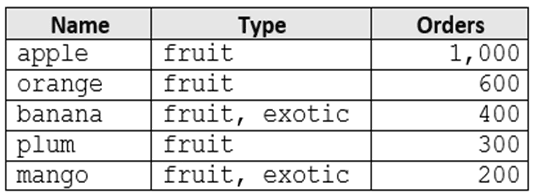
A collection that contains aggregated data already exists. The following is a sample document:
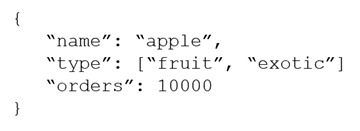
Which two queries can you use to retrieve data for the report? Each correct answer presents a complete solution.
NOTE: Each correct selection is worth one point.
Question 9 Single Choice
You have a container in an Azure Cosmos DB Core (SQL) API account. The container stores telemetry data from IoT devices. The container uses telemetryId as the partition key and has a throughput of 1,000 request units per second (RU/s). Approximately 5,000 IoT devices submit data every five minutes by using the same telemetryId value.
You have an application that performs analytics on the data and frequently reads telemetry data for a single IoT device to perform trend analysis.
The following is a sample of a document in the container.
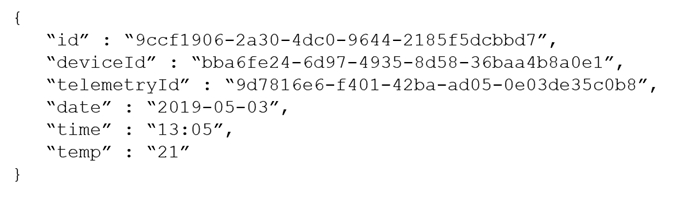
You need to reduce the amount of request units (RUs) consumed by the analytics application.
What should you do?
Question 10 Single Choice
You provision an Azure Cosmos DB for NoSQL container. You set the throughput to Autoscale, and the maximum request units per second (RU/s) to 20,000.
For how many RU/s will you be charged when the actual RU/s usage is zero?
Frequently Asked Questions
How realistic are the practice questions for the DP-420 exam?
The practice questions are designed to closely mirror the style and difficulty of those found on the actual DP-420 exam, helping to ensure that your preparation is relevant and effective.
How should I use these practice questions to prepare for the exam?
It's best to take the practice questions in a timed setting to simulate exam conditions, followed by reviewing explanations for both correct and incorrect answers to reinforce your understanding.
How many practice questions should I complete before taking the actual exam?
While there is no strict number, aiming to complete all 143 practice questions can help ensure a comprehensive review of the material, along with additional study resources.
Can I retake the practice questions, and should I do so?
Yes, you can retake the practice questions to track your improvement over time; doing this helps reinforce knowledge and reveals areas that may require further study.
What should I do if I struggle with certain practice questions?
If you encounter difficulties with specific questions, focus on reviewing the related concepts and revisiting official documentation or tutorials to strengthen your understanding.