Welcome to our comprehensive listing page for independent practice questions and answers for the "Generative AI Leader - Google Cloud Certified" certification. Here, you will find a curated collection of 250 practice questions designed to enhance your understanding and readiness for the exam. Each question simulates the type of content and scenarios you may encounter, providing you with a valuable resource for self-assessment and study.
To make the best use of this resource, begin by reviewing the questions thoroughly, answering them to the best of your ability, and then cross-referencing your answers with the provided explanations. This will not only help solidify your knowledge but also identify areas where you may need to focus your studies further. Regularly revisiting questions will enhance retention and increase your confidence as you approach the exam date.
As you prepare for the "Generative AI Leader" certification, consider these tips to optimize your study approach:
1. Create a Study Schedule: Allocate specific times for study sessions, ensuring consistent engagement with the material. This will help you cover all relevant topics systematically before the exam.
2. Join Study Groups: Engaging with peers who are also preparing for the certification can provide new insights, different perspectives, and accountability, enhancing your overall understanding of the subject matter.
3. Practical Application: Whenever possible, apply concepts learned through hands-on projects or simulations. This real-world application will deepen your comprehension and help solidify your skills.
Use these strategies alongside the practice questions to give yourself the best chance of success. Good luck!
A healthcare provider is implementing a generative AI model to assist doctors with summarizing patient records. Protecting patient data confidentiality is paramount.
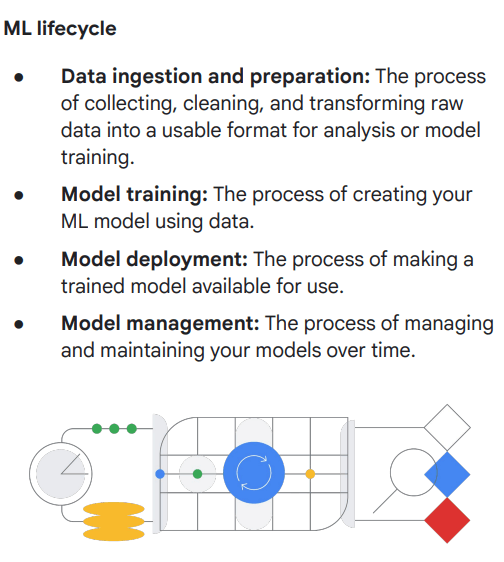
At which stage of the ML lifecycle is it most critical to implement robust data de-identification and access control measures to safeguard this sensitive information?
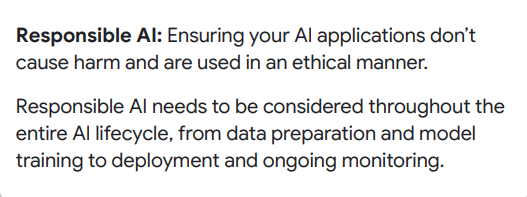
Security, especially for sensitive data like patient records, must be a continuous consideration throughout the entire ML lifecycle, not just at one specific stage.
INCORRECT: Only during model deployment when the model is live.
While security during deployment is crucial, sensitive data can be exposed or mishandled much earlier in the lifecycle (e.g., during data preparation or training).
INCORRECT: Primarily during model monitoring to detect breaches.
Model monitoring is important for detecting issues, including potential security breaches, but proactive security measures must be in place before a breach can occur.
CORRECT: Throughout the entire ML lifecycle, starting from data ingestion and preparation.
Protecting sensitive data requires a defense-in-depth approach. This includes measures like data de-identification, secure storage, strict access controls, and secure processing environments at every stage, from initial data collection and preparation through training, deployment, and ongoing operation.
INCORRECT: Mainly during the model training phase by the data scientists.
While data scientists must handle data securely during training, responsibility for data security is broader and encompasses all stages and personnel involved.


A large enterprise is looking to adopt generative AI across multiple departments. They are concerned about establishing a consistent governance model for AI security, managing risks, and ensuring their AI deployments align with industry best practices and regulatory requirements.
Which Google Cloud offering or framework is specifically designed to help organizations address these AI security governance and risk management challenges?
Google's Secure AI Framework (SAIF) provides a structured approach and best practices for organizations to secure their AI/ML systems and manage associated risks.
INCORRECT: Google Cloud's AI-optimized infrastructure (TPUs, GPUs)
AI-optimized infrastructure provides the hardware for efficient model training and serving, but it's not a framework for AI security governance.
CORRECT: Google's Secure AI Framework (SAIF)
SAIF is a framework inspired by security best practices, designed to help organizations manage the risks associated with AI. It provides guidance on securing AI systems throughout their lifecycle, covering aspects like secure infrastructure, data protection, model security, and responsible deployment. This aligns with the enterprise's need for a consistent governance model for AI security.
INCORRECT: Vertex AI Model Garden
Model Garden is a repository of pre-trained models. It doesn't directly address AI security governance and risk management at an organizational level.
INCORRECT: Google Cloud's open approach to AI
Google's open approach provides flexibility and choice in AI development, but SAIF is the specific framework focused on security and risk management for AI systems.
A large financial institution is planning to adopt generative AI for various internal processes, including sensitive data analysis and customer interaction. Their primary concern is ensuring that the AI platform they choose adheres to strict security protocols, offers robust data privacy controls, and can reliably handle fluctuating workloads.
Which aspect of Google Cloud's AI platform directly addresses these enterprise needs?
Google Cloud's AI platform is designed to be enterprise-ready, emphasizing security, privacy, reliability, and scalability, which are critical for institutions like financial services.
INCORRECT: Its wide range of pre-trained models
While a wide range of models is beneficial, this feature alone doesn't inherently address the core enterprise concerns of security, privacy, and reliability for sensitive operations.
INCORRECT: Its commitment to open-source contributions
Google's open-source contributions are valuable for the AI community and offer flexibility, but they are not the primary features that assure an enterprise of security, privacy, and scalability for their specific deployments.
CORRECT: Its enterprise-ready features like security, privacy, and scalability
Google Cloud explicitly designs its AI platform with enterprise needs in mind. This includes robust security measures (e.g., secure-by-design infrastructure, IAM), data privacy controls (e.g., governance tools, control over data), reliability through its global infrastructure, and scalability to handle varying demands. These are the key aspects the financial institution is concerned about.
INCORRECT: Its low-code/no-code development tools
Low-code/no-code tools democratize AI development and speed up deployment, but they are distinct from the underlying platform characteristics that ensure security, privacy, and scalability for enterprise-grade solutions.
A machine learning engineer is training a model to automatically categorize news articles into predefined topics like "Sports," "Politics," and "Technology." To do this, they have a dataset where each article has already been manually assigned one of these topic categories by a human annotator.
What type of data is the engineer primarily using for this training process?
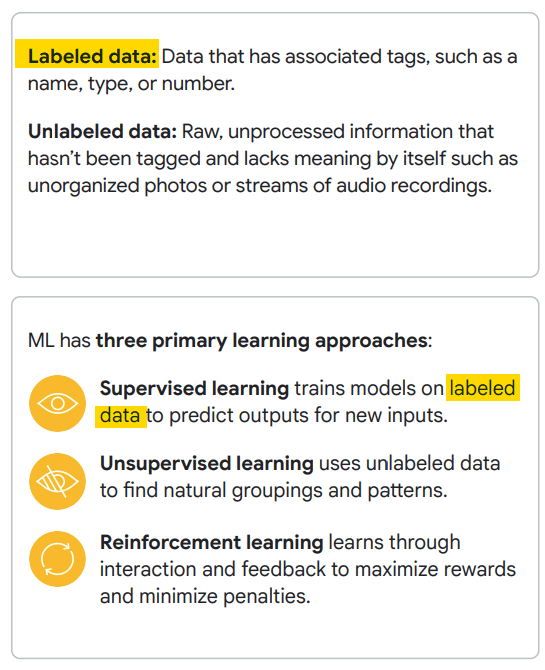
The data consists of news articles (inputs) that have been manually assigned topic categories (outputs/tags). This is the definition of labeled data.
INCORRECT: Unstructured Data
While news articles are text and thus a form of unstructured data, the crucial characteristic for this scenario is that they have been annotated with topic categories. The question focuses on the presence of these annotations.
INCORRECT: Unlabeled Data
Unlabeled data lacks explicit output tags or classifications. The scenario clearly states that each article has been assigned a topic category.
INCORRECT: Structured Data
Structured data is organized in a predefined format, like tables. While the labels could be stored in a structured way alongside the articles, the core data (articles + their assigned topics) is best described as labeled, with the articles themselves being unstructured.
CORRECT: Labeled Data
Labeled data consists of input data paired with corresponding output labels or tags. In this case, the news articles are the inputs, and the predefined topic categories ("Sports," "Politics," "Technology") assigned by human annotators are the labels. This type of data is essential for supervised machine learning tasks like classification.

A user interacts with a mobile app that allows them to upload a photo of their living room and, using generative AI, see different interior design styles applied to their space in real-time. In the context of the generative AI landscape, what does this mobile app primarily represent?
The mobile app is the user-facing tool that leverages generative AI capabilities, making it an Application in the gen AI landscape.
INCORRECT: Infrastructure
Infrastructure refers to the underlying compute resources (servers, GPUs, etc.) that power the AI. The app runs on a device that uses this infrastructure, but the app itself is not the infrastructure.
INCORRECT: Model
The model is the AI algorithm (e.g., an image generation model) that performs the style transformation. The app uses a model, but it is not the model itself.
INCORRECT: Platform
A platform would provide tools and services for developing and deploying such an app or model. The app is built on or using a platform, but it's the end-user product.
CORRECT: Application
The Application layer is the user-facing part of generative AI. The mobile app described is a direct interface for the end-user to interact with and benefit from the generative AI technology.

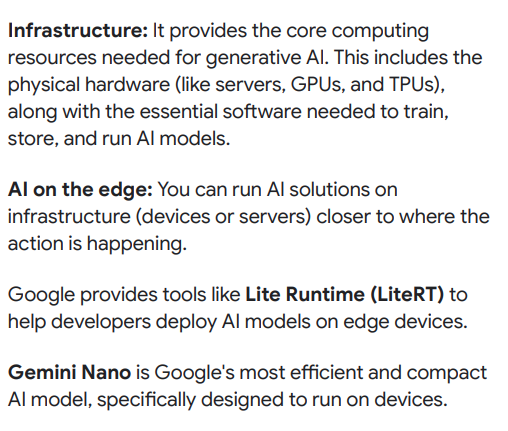
A research institution is embarking on a project that requires training extremely large and complex generative AI models. They anticipate needing massive computational power specifically optimized for machine learning workloads to accelerate the training process and reduce costs.
Which component of Google Cloud's AI-optimized infrastructure is custom-designed by Google to provide this type of specialized acceleration for ML tasks?
Google's Tensor Processing Units (TPUs) are custom-designed ASICs specifically built to accelerate machine learning workloads, making them ideal for training very large models.
INCORRECT: Standard CPUs available in Compute Engine
While CPUs are general-purpose processors and essential for many computing tasks, they are not as specialized or efficient for large-scale ML training as TPUs or GPUs.
INCORRECT: Google's global network of data centers
Google's data centers provide the foundational infrastructure, but the specific component responsible for ML acceleration within those data centers is what the question is targeting. The data centers house the TPUs.
CORRECT: Google's custom-designed Tensor Processing Units (TPUs)
TPUs are Google's purpose-built hardware accelerators optimized for training and running machine learning models, particularly deep learning models. They offer significant performance and cost-efficiency benefits for large-scale ML tasks.
INCORRECT: Cloud Storage for model and data persistence
Cloud Storage is essential for storing the data and models, but it does not provide the computational acceleration needed for training the models.

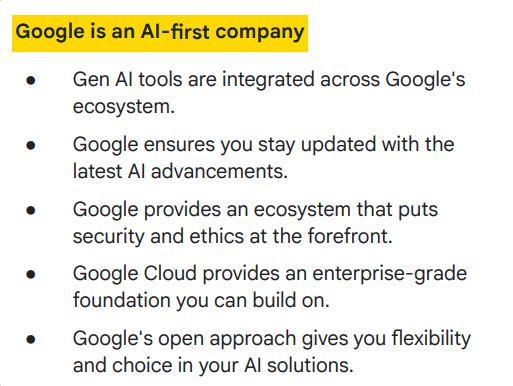
A technology company prides itself on being at the forefront of innovation. When choosing a cloud provider for their generative AI initiatives, they prioritize a partner that not only offers robust current solutions but also demonstrates a deep commitment to ongoing research and development, ensuring access to the latest advancements in AI.
Which characteristic of Google Cloud best aligns with this priority?
Google's "AI-first" philosophy and its significant, ongoing investments in AI research (e.g., through Google DeepMind) ensure that its cloud offerings continuously incorporate cutting-edge AI advancements.
INCORRECT: Its extensive global data center network.
While data centers are crucial for delivering AI services, the network itself doesn't inherently signify a commitment to future AI innovation as much as the research and development focus does.
INCORRECT: Its flexible pay-as-you-go pricing model.
Flexible pricing is a general cloud benefit but doesn't specifically address the desire for access to the latest AI advancements stemming from R&D.
CORRECT: Google's AI-first approach and continuous investment in AI research and innovation.
Google has long declared itself an "AI-first" company, meaning AI is central to its strategy and product development. Its substantial investments in fundamental AI research (e.g., Transformers, TPUs, models like Gemini) translate into cutting-edge solutions and a commitment to bringing future innovations to its cloud platform. This directly aligns with the company's priority.
INCORRECT: Its comprehensive documentation and support services.
Good documentation and support are important for usability but are secondary to the core commitment to research and innovation when selecting a partner for access to future AI breakthroughs.

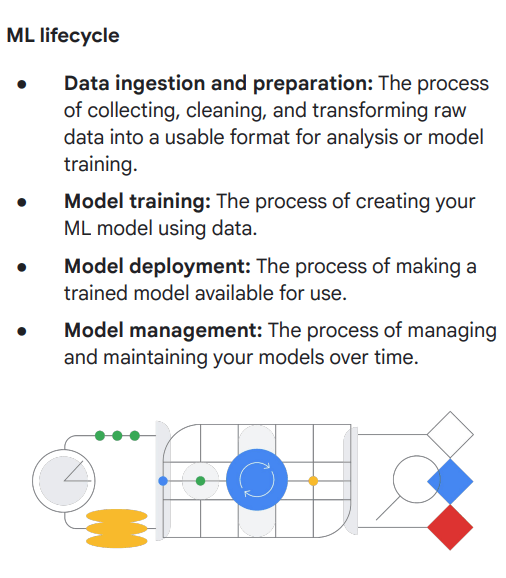
A financial services company has gathered extensive raw transactional data. The team needs to clean this data, handle missing values, and transform it into a suitable format before training a fraud detection model.
Which stage of the machine learning lifecycle does this activity primarily belong to?
The process of cleaning, handling missing values, and transforming raw data into a usable format for model training is known as Data Preparation.
INCORRECT: Model Training
Model training is the stage where an algorithm learns from the prepared data to build a model. This occurs after data preparation.
CORRECT: Data Preparation
Data preparation involves all activities to construct the final dataset that will be fed into the machine learning algorithm. This includes cleaning, transforming, and feature engineering the raw data. The scenario clearly describes these activities.
INCORRECT: Model Deployment
Model deployment is the stage where a trained model is made available for use in a production environment to make predictions on new data. This happens much later in the lifecycle.
INCORRECT: Data Ingestion
Data ingestion is the process of collecting raw data from various sources. While it's an early stage, the activities described (cleaning, transforming) are distinctly part of data preparation, which typically follows ingestion.

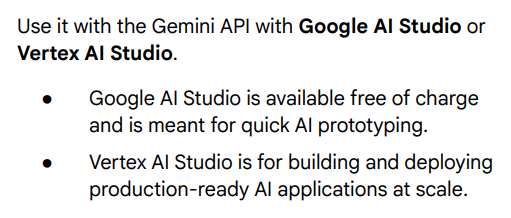
A developer is beginning to explore generative AI capabilities for a new project. They want to quickly experiment with prompting Google's latest foundation models, like Gemini, without needing to set up a full cloud environment or incur significant costs initially. Their primary goal is rapid prototyping and understanding the model's behavior with different inputs.
Which Google Cloud tool would be most appropriate for this initial, cost-effective experimentation and prototyping phase?
Google AI Studio is designed for quick, free-of-charge prototyping and experimentation with generative AI models like Gemini.
INCORRECT: Vertex AI Studio
Vertex AI Studio is part of the Vertex AI platform and is geared towards building and deploying production-ready AI applications at scale. While it offers powerful capabilities, Google AI Studio is positioned as the entry point for more lightweight, initial prototyping.
CORRECT: Google AI Studio
Google AI Studio provides a web-based interface for developers to quickly prototype and experiment with generative models like Gemini. It is often available free of charge for initial exploration and is ideal for understanding model capabilities before moving to more robust development environments like Vertex AI Studio for production use cases.
INCORRECT: A custom-built application using the Gemini API directly
While using the API directly offers maximum flexibility, it requires more setup and coding effort than using a dedicated prototyping studio, which is what the developer wants to avoid for initial experimentation.
INCORRECT: Vertex AI Pipelines
Vertex AI Pipelines is for orchestrating and automating ML workflows, which is more advanced than the initial prototyping and experimentation phase described.

A retail company is exploring AI solutions to improve customer engagement. They are particularly interested in a technology that can learn from vast amounts of unlabeled customer interaction data (like chat logs and product reviews) to identify underlying patterns and themes without explicit instructions on what to look for.
Which machine learning approach best fits this requirement?
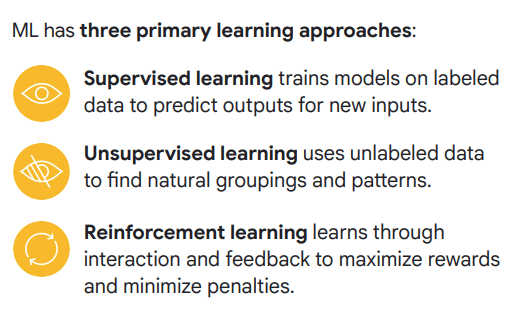
The scenario describes a need to find patterns and themes in unlabeled data without explicit instructions. This is characteristic of Unsupervised Learning.
INCORRECT: Supervised Learning
Supervised learning requires labeled data, where each data point is tagged with a correct output. The company has unlabeled customer interaction data.
CORRECT: Unsupervised Learning
Unsupervised learning is used when the information used to train is neither classified nor labeled. It's designed to allow the model to discover patterns and information on its own from unlabeled data, such as identifying customer segments or common topics in reviews.
INCORRECT: Reinforcement Learning
Reinforcement learning involves an agent learning to make a sequence of decisions by trying to maximize a reward it receives for its actions. This is not suitable for finding patterns in existing, unlabeled data.
INCORRECT: Deep Learning
Deep learning is a subset of machine learning that uses artificial neural networks with many layers. While deep learning models can be used for unsupervised tasks, "Unsupervised Learning" is the specific approach or category of machine learning that directly addresses the problem of finding patterns in unlabeled data. Deep learning is a technique that can be applied within that approach.

Frequently Asked Questions
How realistic are the practice questions for the Generative AI Leader exam?
The practice questions are designed to closely mimic the style and difficulty of the actual exam, helping you become familiar with the format and the types of scenarios you'll encounter.
How should I use the practice questions to prepare for the exam?
You should regularly complete sets of practice questions, review the explanations for any incorrect answers, and focus on areas where you need improvement to ensure a comprehensive understanding of the material.
How many practice questions should I complete before taking the real exam?
While there isn't a specific number, it's recommended to complete as many questions as possible to build confidence, ideally reviewing around 200 to 250 questions to cover a broad range of topics.
Can I expect to see similar questions from the practice exam on the actual certification exam?
While the practice questions reflect the exam's structure and concepts, the exact questions will differ; however, mastering these will boost your confidence and readiness for the real exam.
What should I do if I'm struggling with some practice questions?
If you struggle with certain practice questions, revisit the relevant study materials, take notes, and consider reaching out to study groups or forums for additional support and clarification.