Welcome to our comprehensive listing page for independent practice questions and answers for the "Generative AI Leader - Google Cloud Certified" certification. Here, you will find a curated collection of 250 practice questions designed to enhance your understanding and readiness for the exam. Each question simulates the type of content and scenarios you may encounter, providing you with a valuable resource for self-assessment and study.
To make the best use of this resource, begin by reviewing the questions thoroughly, answering them to the best of your ability, and then cross-referencing your answers with the provided explanations. This will not only help solidify your knowledge but also identify areas where you may need to focus your studies further. Regularly revisiting questions will enhance retention and increase your confidence as you approach the exam date.
As you prepare for the "Generative AI Leader" certification, consider these tips to optimize your study approach:
1. Create a Study Schedule: Allocate specific times for study sessions, ensuring consistent engagement with the material. This will help you cover all relevant topics systematically before the exam.
2. Join Study Groups: Engaging with peers who are also preparing for the certification can provide new insights, different perspectives, and accountability, enhancing your overall understanding of the subject matter.
3. Practical Application: Whenever possible, apply concepts learned through hands-on projects or simulations. This real-world application will deepen your comprehension and help solidify your skills.
Use these strategies alongside the practice questions to give yourself the best chance of success. Good luck!
A software company has launched a new generative AI-powered feature that helps users write code more efficiently. To demonstrate the value of this feature to stakeholders, the product manager needs to quantify its impact.
Which of the following would be the most direct and relevant metric to measure the success of this specific gen AI initiative?
The most direct measure of a feature designed to improve code writing efficiency is the actual reduction in time developers take to complete their coding tasks when using it.
INCORRECT: The number of lines of code in the gen AI model itself.
The size or complexity of the AI model doesn't directly measure its impact on user efficiency.
INCORRECT: The average time developers spend in meetings discussing the feature.
While feedback is important, meeting time isn't a direct measure of the feature's efficiency benefits.
CORRECT: The reduction in average time taken by developers to complete coding tasks using the feature.
This metric directly quantifies the efficiency gains provided by the generative AI feature. If developers are completing tasks faster with the AI's help, it demonstrates a clear positive impact on their productivity, which was the goal.
INCORRECT: The overall revenue growth of the company in the quarter after launch.
Overall company revenue can be influenced by many factors. While the AI feature might contribute indirectly, it's not a direct or specific measure of the feature's impact on coding efficiency.
A bank uses a generative AI model to assess loan applications. A customer whose loan application was denied by the AI system requests a clear reason for the decision. For the bank to maintain customer trust and comply with potential regulations, it's important that the AI system's decision-making process can be understood and its outputs justified.
Which two principles of responsible AI are most directly relevant to this situation?
Accountability means there are mechanisms to attribute responsibility for the AI's decisions, and explainability means the AI's decisions can be understood by humans. Both are crucial when an AI makes impactful decisions like loan denials.
INCORRECT: Privacy and Security
While privacy of the applicant's data and security of the system are vital, the customer's request is about understanding the reason for the denial, which relates to explainability and the bank's accountability for that decision.
INCORRECT: Reliability and Scalability
Reliability (consistent performance) and scalability (handling load) are important system qualities but don't directly address the need to explain a specific decision.
CORRECT: Accountability and Explainability
Explainability (or interpretability) refers to the ability to understand how an AI model arrived at a specific decision. Accountability involves having clear lines of responsibility for the outcomes of AI systems. When a loan is denied, the customer needs an explanation (explainability), and the bank needs to be able to stand by that decision and the process (accountability).
INCORRECT: Bias and Fairness
While bias and fairness are critical concerns (and a lack of them could lead to a denial that needs explaining), the immediate need highlighted by the customer's request is for an explanation of the decision and the bank's accountability for it.
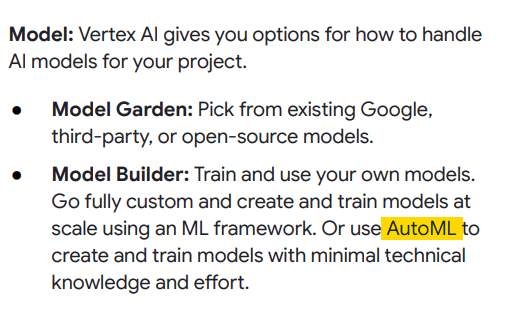
A retail company has a large dataset of customer purchase history and product information. They want to train a custom machine learning model to predict which products a customer is most likely to purchase next, but their data science team has limited experience with complex model development. They need a solution on Google Cloud that can automate much of the model building process, allowing them to create a high-quality custom model with minimal manual intervention.
Which feature of Vertex AI Platform is best suited for this?
AutoML on Vertex AI Platform automates the process of training custom machine learning models, making it ideal for teams with limited ML expertise.
INCORRECT: Model Garden
Model Garden provides access to pre-trained foundation models. While these can be fine-tuned, AutoML is specifically designed to build custom models from scratch using the company's own data with high levels of automation.
INCORRECT: Vertex AI Search
Vertex AI Search is for building search and recommendation applications, often leveraging pre-built capabilities, rather than training custom prediction models from tabular data in an automated fashion.
CORRECT: AutoML
Vertex AI AutoML enables developers with limited machine learning expertise to train high-quality models specific to their business needs. It automates tasks like feature engineering, model selection, and hyperparameter tuning for various data types, including tabular data (like customer purchase history) for prediction tasks.
INCORRECT: Vertex AI Vizier (for hyperparameter tuning)
Vertex AI Vizier is a black-box optimization service, often used for hyperparameter tuning. While AutoML uses such techniques internally, AutoML itself is the broader, end-to-end solution for automated model training.

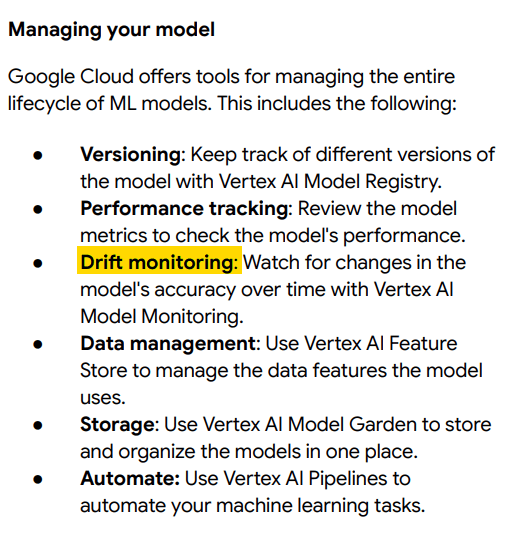
A company has deployed a generative AI model that provides real-time product recommendations on its e-commerce site. Over time, they notice that the quality of recommendations seems to be degrading, and customer click-through rates on these recommendations are declining. The underlying customer preferences and product catalog have evolved since the model was initially trained.
Which Google-recommended practice is crucial for detecting and addressing this kind of performance degradation?
Continuous performance tracking and drift monitoring are essential for identifying when a model's performance degrades due to changes in data or concepts over time.
INCORRECT: Implementing strict versioning for all model deployments.
Versioning is important for managing model deployments and rollbacks but doesn't inherently detect performance degradation.
INCORRECT: Relying solely on automatic model upgrades provided by the cloud vendor.
While automatic upgrades can provide newer base models, they don't address performance degradation specific to the company's evolving data and use case without active monitoring and potential retraining or fine-tuning.
CORRECT: Continuous performance tracking and drift monitoring.
Performance tracking involves monitoring key performance indicators (KPIs) like click-through rates. Drift monitoring specifically looks for changes in the statistical properties of the input data (data drift) or the relationship between inputs and outputs (concept drift). Both are critical for detecting when a model's performance is no longer optimal due to evolving real-world conditions, as described in the scenario.
INCORRECT: Storing all training data indefinitely in Vertex AI Feature Store.
Vertex AI Feature Store is useful for managing features for training, but simply storing data doesn't address the ongoing monitoring and detection of performance issues in a deployed model.

A media company wants to use a foundation model to generate short video clips from text descriptions for social media.
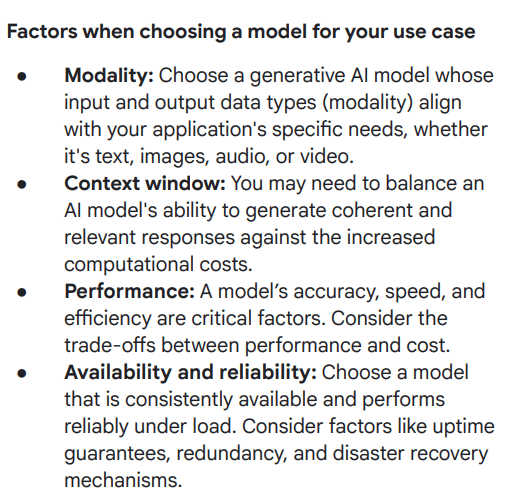
When selecting a foundation model, which of the following characteristics would be the MOST critical initial consideration for this specific use case?
Since the core requirement is to generate video from text, the model's ability to handle these specific data types (modalities) is the most fundamental initial consideration.
INCORRECT: Cost per generated token
Cost is an important factor, but if the model cannot handle the required modalities (text input, video output), its cost is irrelevant for this use case.
CORRECT: Modality (the type of data the model can process and generate)
Modality refers to the types of data a model can work with (e.g., text, images, audio, video). For generating video clips from text, the company must choose a model that supports text as input and video as output. This is a primary filter before considering other factors.
INCORRECT: Availability of fine-tuning options
Fine-tuning might be considered later to improve performance on specific styles or content, but first, the model must be capable of the basic text-to-video generation task.
INCORRECT: The size of the model's context window for text input
The context window (how much text the model can consider at once) is relevant for text processing, but the primary gating factor here is whether the model can output video at all. If it can't, the text context window size is secondary for this specific use case's core need.

A company uses a foundation model to generate summaries of news articles. Users report that for very recent events (those occurring in the last few days), the summaries sometimes miss key developments or include outdated information. The model itself was trained on a massive dataset, but its training concluded several months ago.
What common limitation of foundation models is most likely causing this issue?
The model's inability to incorporate very recent information is due to its knowledge cutoff, which is the point in time when its training data ends.
INCORRECT: Bias
Bias refers to the model reflecting skewed perspectives or unfair representations present in its training data. While a potential issue, it doesn't directly explain the lack of knowledge about very recent events.
INCORRECT: Hallucinations
Hallucinations occur when a model generates plausible but factually incorrect or nonsensical information. While the outdated information might seem like a hallucination, the root cause is the model's lack of exposure to data post its training period.
CORRECT: Knowledge Cutoff
Foundation models are trained on data up to a certain point in time (the knowledge cutoff). They do not inherently have access to or awareness of events or information that have occurred after this date. This explains why the summaries for very recent events are incomplete or outdated.
INCORRECT: Data Dependency
Data dependency refers to the model's performance being heavily reliant on the quality and characteristics of its training data. While true for all models, "knowledge cutoff" is the specific limitation describing the temporal boundary of its knowledge.

A company wants to quickly build a chatbot that can answer employee questions based on a large repository of internal HR policy documents. They want the chatbot to provide answers grounded in these documents to ensure accuracy and avoid making things up. They prefer a solution that minimizes complex setup and leverages Google's search capabilities.
Which Google Cloud offering would be most suitable for rapidly implementing this RAG-based chatbot?
Vertex AI Search offers prebuilt RAG capabilities, allowing businesses to easily ground generative AI applications in their own data, such as internal documents.
INCORRECT: Training a custom foundation model from scratch using Vertex AI.
Training a foundation model from scratch is a complex and resource-intensive undertaking, not suitable for quickly building a RAG-based chatbot for internal documents.
CORRECT: Using prebuilt RAG capabilities within Vertex AI Search.
Vertex AI Search is designed to power search and conversational AI applications grounded in enterprise data. Its features allow for connecting to data sources (like HR documents) and using them to provide grounded, relevant answers, effectively providing a prebuilt RAG solution.
INCORRECT: Manually implementing RAG using Cloud Storage and custom vector database integrations.
While possible, this approach requires significant development effort to set up the retrieval pipeline, vector embeddings, and integration with an LLM, which contradicts the desire for a solution that "minimizes complex setup."
INCORRECT: Deploying a generic LLM via Vertex AI Endpoints and handling retrieval separately.
This is similar to the manual implementation option; it doesn't leverage Google Cloud's integrated RAG offerings for a quicker, more streamlined solution.

A startup is developing an application that allows users to type a short story plot, and the application then generates a unique, coherent, and contextually relevant oil painting visualizing a key scene from that plot.
Which specific type of generative AI model is most likely at the core of the image creation capability?
Diffusion models are a state-of-the-art class of generative models particularly effective for generating high-quality images from text prompts.
INCORRECT: Large Language Model (LLM)
LLMs are primarily designed to understand and generate text. While they might be used to process the input story plot, the actual image generation would typically be handled by a different type of model specialized for visual content.
CORRECT: Diffusion Model
Diffusion models are a type of generative model that have shown exceptional results in generating high-fidelity images from text descriptions (text-to-image generation). They work by iteratively adding noise to training images and then learning to reverse the process, starting from noise and a conditioning input (like text) to generate a new image.
INCORRECT: Supervised Learning Model
While the training of generative models involves learning from data, "Supervised Learning Model" describes a broad category of ML based on labeled data, not a specific type of generative model known for high-quality image synthesis from text.
INCORRECT: Reinforcement Learning Model
Reinforcement learning models learn by interacting with an environment and receiving rewards or penalties. This paradigm is not typically the primary approach for generating images from textual descriptions.

A healthcare organization wants to use generative AI to analyze physician's notes from patient consultations to identify potential trends in reported symptoms. These notes are free-form text, varying greatly in length, style, and content for each patient visit.
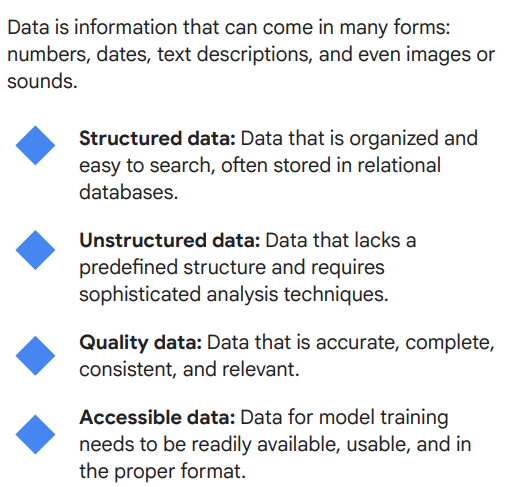
What type of data are these physician's notes primarily considered?
Physician's notes, being free-form text without a predefined format, are a classic example of unstructured data.
INCORRECT: Structured Data
Structured data is highly organized and formatted in a way that makes it easily searchable and analyzable, typically residing in relational databases (e.g., tables with rows and columns). Free-form text notes do not fit this description.
INCORRECT: Labeled Data
Labeled data has been tagged with one or more labels identifying certain properties or characteristics. While these notes could be labeled (e.g., with a diagnosis code), the description of them as "free-form text" primarily points to their structural nature, not necessarily their annotation status.
CORRECT: Unstructured Data
Unstructured data does not have a predefined format or organization. Examples include text documents, emails, social media posts, images, and audio/video files. Physician's free-form notes clearly fall into this category.
INCORRECT: Time-series Data
Time-series data is a sequence of data points indexed in time order. While patient records are often associated with dates, the nature of the free-form text notes themselves is unstructured, not inherently time-series, although they can be part of a patient's longitudinal record.

An AI is being trained to play a complex board game. The AI learns by making moves in the game, and after each game (or series of moves), it receives a signal indicating whether it won (a positive reward) or lost (a negative reward). The AI's goal is to learn a strategy that maximizes its chances of winning over time.
Which machine learning approach is primarily being used here?
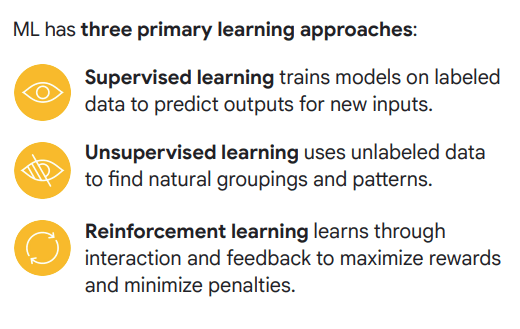
Reinforcement learning is characterized by an agent learning through trial and error by interacting with an environment and receiving rewards or penalties for its actions.
INCORRECT: Supervised Learning
Supervised learning requires labeled data where each input has a known correct output. In game playing, the "correct" move is not always known beforehand; the agent learns it through experience.
INCORRECT: Unsupervised Learning
Unsupervised learning aims to find patterns in unlabeled data. It's not typically used for learning to play a game based on win/loss signals.
CORRECT: Reinforcement Learning
Reinforcement learning is an area of machine learning concerned with how intelligent agents ought to take actions in an environment in order to maximize the notion of cumulative reward. The AI playing the board game, making moves (actions), and receiving win/loss signals (rewards/penalties) is a classic example of a reinforcement learning problem.
INCORRECT: Multimodal Learning
Multimodal learning involves processing and relating information from multiple types of data (e.g., text and images). While a game AI could be multimodal if it processed visual board states and text rules, the core learning mechanism described (learning from rewards/penalties based on actions) is reinforcement learning.

Frequently Asked Questions
How realistic are the practice questions for the Generative AI Leader exam?
The practice questions are designed to closely mimic the style and difficulty of the actual exam, helping you become familiar with the format and the types of scenarios you'll encounter.
How should I use the practice questions to prepare for the exam?
You should regularly complete sets of practice questions, review the explanations for any incorrect answers, and focus on areas where you need improvement to ensure a comprehensive understanding of the material.
How many practice questions should I complete before taking the real exam?
While there isn't a specific number, it's recommended to complete as many questions as possible to build confidence, ideally reviewing around 200 to 250 questions to cover a broad range of topics.
Can I expect to see similar questions from the practice exam on the actual certification exam?
While the practice questions reflect the exam's structure and concepts, the exact questions will differ; however, mastering these will boost your confidence and readiness for the real exam.
What should I do if I'm struggling with some practice questions?
If you struggle with certain practice questions, revisit the relevant study materials, take notes, and consider reaching out to study groups or forums for additional support and clarification.